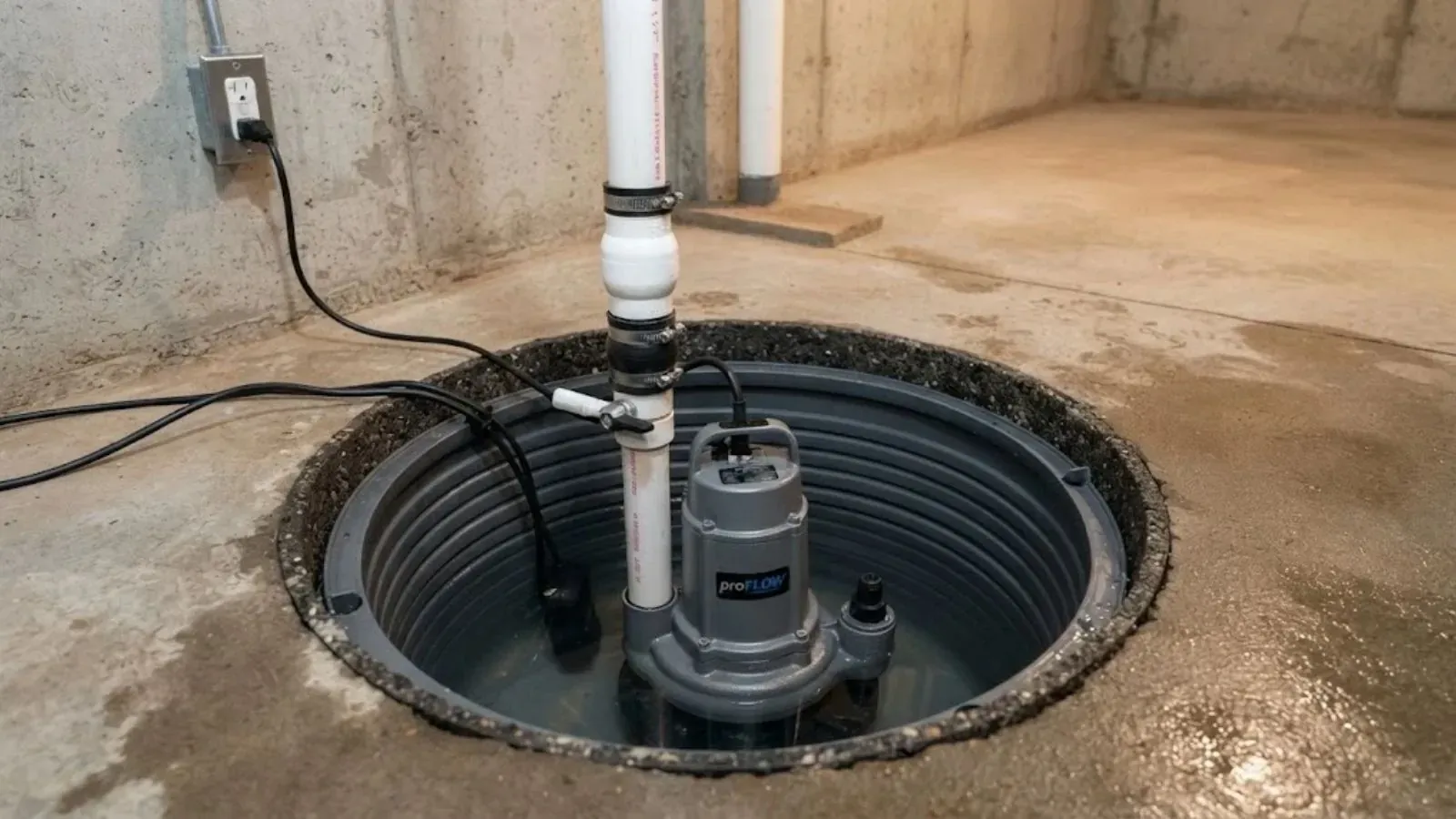
A sump pump is a simple machine in a not-so-simple setting. The pit, the float, the check valve and the discharge all have to work together, and a mistake shows up in the worst storm.
This guide explains how an installation works, so you can judge a quote or decide how much you want to do yourself.
If your pit is filling now and the pump is dead, check the plug and the GFCI first, then call the 24/7 line.
The Parts And What Each One Does
| Part | Job | Common mistake |
|---|---|---|
| Pit and liner | Collects water below the floor | Too small, causing short cycling |
| Pump | Moves water out of the pit | Undersized for the lift |
| Float switch | Starts the pump at a set level | Stuck against the wall of the pit |
| Check valve | Stops water falling back | Missing or installed backward |
| Discharge pipe | Carries water outside | Ends too close to the house |
| Backup power | Keeps the pit dry in an outage | Skipped entirely |
Step By Step
- 1Locate and cut the pit
A pit goes at the lowest point where water collects. Cutting concrete is dusty, heavy work.
- 2Set the liner and gravel
The liner sits level on a gravel bed, and the slab is patched around it.
- 3Place the pump
The pump sits on a flat base and the float swings free.
- 4Add the check valve and discharge
The pipe rises, passes through the rim joist and exits at least several feet from the foundation.
- 5Power and test
A dedicated GFCI outlet feeds the pump. Fill the pit with a hose and watch a full cycle.
Cutting the slab and routing the discharge are the hard parts. Many homeowners buy the pump and hire the rest. Our sump pump repair page shows what a plumber checks.
Want a plumber on the way? The line is open all day and all night.
☎ Call (732) 466-1098Where The Water Should Go
Discharge should drain away from the house onto ground that slopes down. Do not connect it to the sanitary sewer, since the township's sewer is not meant for stormwater. Ask the North Brunswick building department what local rules apply to your lot.
In winter, a discharge that ends in the open can freeze. A short drop with a free-flowing outlet helps, and a screen keeps animals out.
Permits, Mark-Outs And Ida
Before digging outside, call New Jersey 811 so buried utilities are marked. Ask the building department whether a permit or inspection applies to a new pit or electrical circuit.
The reminder for planning comes from the township's own history. Tropical Storm Ida's floodwater on September 1, 2021 knocked out electrical service at the municipal complex on Hermann Road. A battery backup keeps a pump running when the grid does not.
Choosing Between Submersible And Pedestal Pumps
A submersible pump sits in the pit and runs quietly. It handles heavy use well and does not take up floor space. A pedestal pump sits above the pit on a column, costs less and is easier to service, though it is louder and has a shorter life in heavy use.
For a pit that sees regular water, most plumbers lean toward submersible units. For a pit that rarely runs, a pedestal pump may do. Ask about the float type too, since a tethered float needs more room to swing than a vertical float.
Sizing The Pump To The Job
Two numbers decide the size. How much water has to move, and how high it has to lift it to the discharge point. A pump moving water up a tall wall and across a long yard needs more power than one shooting it out a nearby window well.
An undersized pump runs constantly and wears out. An oversized pump short cycles and wears out too. A plumber who asks about both is doing the work right.
Testing Your New Pump
Pour a bucket of water into the pit and watch the float rise. The pump should start, drain the pit and shut off without chattering. Check the discharge outside and make sure water flows away from the house.
Repeat the test every few months. A pump that sits idle for a year can seize, and a quick test is the cheapest insurance you can buy. The install falls under the state plumbing and electrical subcodes, and the National Standard Plumbing Code Illustrated, 2021 edition, is the plumbing reference.
When To Hire Instead
Hire a plumber if the slab must be cut, if the discharge crosses a driveway, if no outlet exists or if the basement already floods. See basement waterproofing for larger systems.
Homeowners in Milltown near Lawrence Brook and in East Brunswick near Farrington Lake often have the lowest basements, so plan carefully.
Local questions answered
Large enough that the pump does not cycle every few seconds. A plumber sizes it to the water volume.
Yes. Without one, water in the discharge pipe falls back into the pit.
No. Stormwater should not go to the sanitary sewer. Ask the building department about local rules.
A battery backup or a water-powered backup. Each has trade-offs, and a plumber can advise.
Yes, before any outside digging. New Jersey 811 marks buried utilities.
Ready to talk to a plumber? The line is open all day and all night.
☎ Call (732) 466-1098