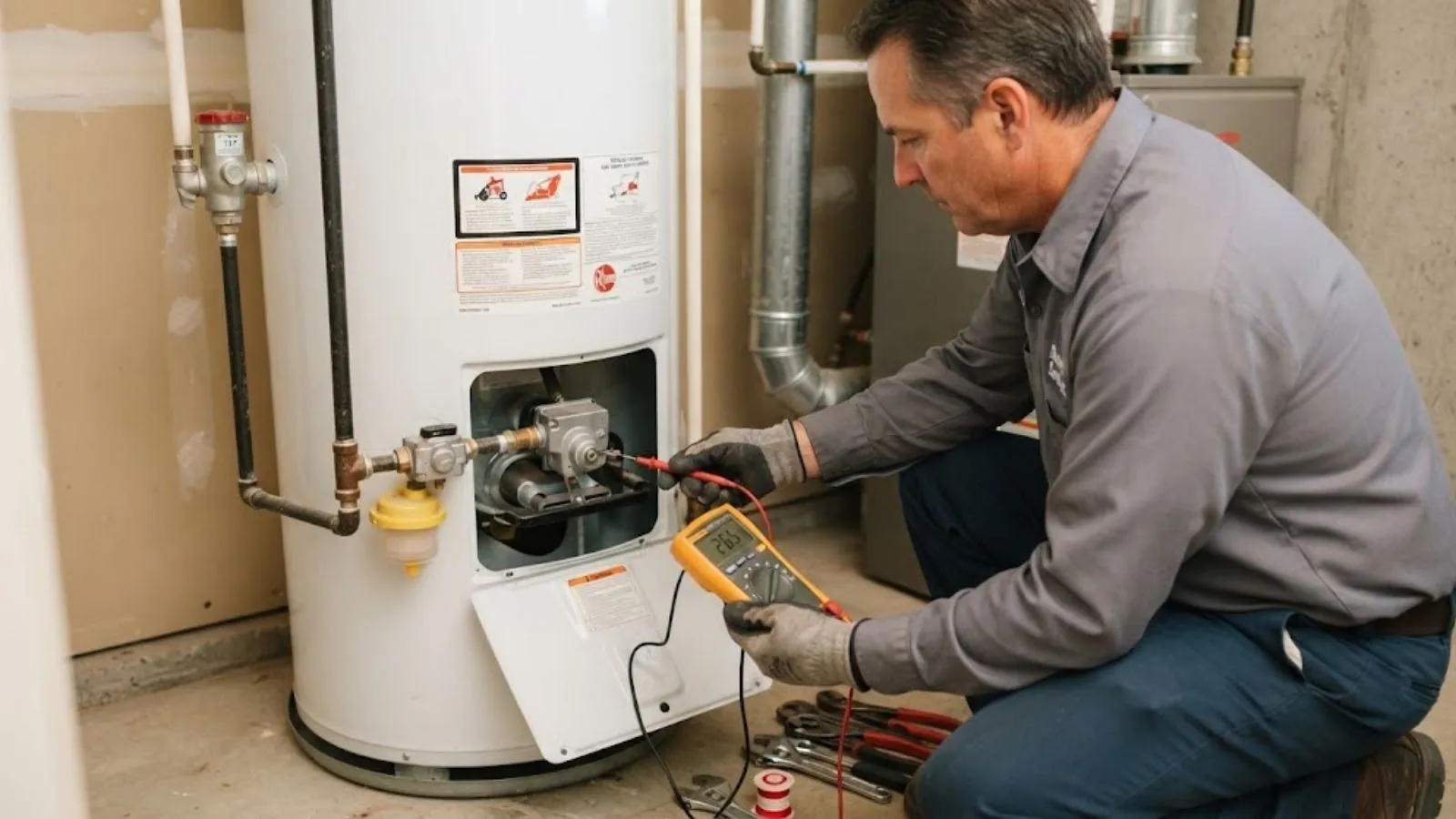
If you have no hot water or a heater is leaking, call for emergency water heater repair in North Brunswick, NJ. The 24/7 line is answered at night, and we offer same-day appointments when available.
While you wait, turn off the cold water supply valve above the tank if it is leaking. Switch an electric unit off at the breaker, or set a gas unit to pilot or off. If you smell gas, leave the house and call 911 or PSE&G at 1-800-880-7734 before you call us.
Many failures are repairable: a thermostat, a heating element, a gas valve or a thermocouple. Others point to a tank at the end of its life, and then water heater replacement is the honest answer. We tell you which one applies.
Urgent Signs Your Water Heater Cannot Wait
Call the 24/7 line now if
- Water is leaking from the tank body or the bottom, not just a fitting.
- The tank is hot to the touch at the relief valve and steam or hot water is discharging.
- You smell gas near the heater, or the pilot keeps going out and a burner flame looks yellow.
- The unit makes loud banging or popping and the water is rusty.
- There is no hot water at all and the household includes infants, elderly people or someone with a medical need.
A slow drip at a fitting is different from a tank that is leaking. A fitting can often be tightened or replaced. A rusted tank cannot be patched.
Symptoms And Likely Causes
| Symptom | Common cause | Usual fix |
|---|---|---|
| No hot water, electric unit | Tripped breaker, failed element or thermostat | Reset, then replace the failed part |
| No hot water, gas unit | Pilot out, bad thermocouple or gas valve | Relight or replace the part |
| Water lukewarm, runs out fast | Sediment on the bottom, lower element failed | Flush the tank, replace the element |
| Rumbling or popping | Scale and sediment boiling under the heater | Flush now, plan for replacement if old |
| Water at the base | Fitting leak, relief valve or a leaking tank | Tighten or replace the fitting, or replace the tank |
| Rusty or smelly hot water | Corroded tank or spent anode rod | Replace the anode or the tank |
No hot water or a leak at the tank? Call the 24/7 line now.
☎ Call (732) 466-1098Gas, Electric And Hybrid Heaters
A gas heater depends on a pilot or igniter, a thermocouple, a gas control valve and proper venting. A failed thermocouple is a small part, but a venting problem is a safety issue, and a heater with a blocked vent should stay off until it is fixed.
An electric heater has two heating elements and two thermostats. Often only one fails, which is why the water turns lukewarm instead of cold. A hybrid heat pump unit adds a compressor and fan, and we check the condensate drain, filter and airflow before we blame the tank.
If a part costs a small fraction of a new heater and the tank is sound, repair is sensible. If the tank is leaking, we say so and move to replacement or to a tankless option.
Anode Rods And How Long A Tank Lasts
Inside a steel tank sits a sacrificial anode rod. It corrodes so the tank does not. Once the rod is used up, the steel starts to rust, and rusty hot water or a rotten-egg smell is the usual first sign.
Checking the rod is a short job on a tank that is not too old. Swapping a spent rod can add years to a sound tank. On a tank that has already started to weep at the seams, a new rod comes too late, and replacement is the better use of money.
Ask for the rod to be inspected at any repair visit. It costs little to look and tells you a lot about what the inside of the tank looks like.
Temperature Settings And Scald Safety
A tank set too low can let bacteria grow, and one set too high can scald a child in seconds. Many plumbers suggest a setting that balances safety and comfort, and an anti-scald mixing valve at the heater lets you store hotter water while delivering a safer temperature to the taps.
If the water runs hot and cold at random, the thermostat or a mixing valve may be failing. A thermostat is a small part, but it is the part that decides whether the water is safe, so it is worth fixing properly.
Is It Worth Repairing?
A tank heater usually lasts roughly a decade in many homes. The age is on the data plate, and the serial number often encodes the month and year. A newer unit with a bad part is a repair. An older unit with rust at the base is a replacement.
Our rule is simple: if the repair is cheap and the tank is sound, repair. If the tank is leaking, or the unit is old and needs a costly part, put that money toward a new heater. We give you both numbers so the choice is yours.
Hard Water And Your Tank In North Brunswick
The township's water utility, operated by Veolia, reported hardness of 67.5 ppm as calcium carbonate in its 2022 water quality report. That is about 3.9 grains per gallon, which is moderately hard. Scale builds up slowly rather than quickly, but it does build up.
Flushing a tank heater once a year removes sediment before it insulates the burner or covers the bottom element. If it has never been flushed, call us before you try it yourself, since a long-neglected drain valve can break when opened.
The relief valve and its discharge pipe are code items under the New Jersey plumbing subcode, the National Standard Plumbing Code Illustrated, 2021 edition, and they are the first parts we check.
What Affects The Cost Of Water Heater Repair
The failed part
A thermocouple or relief valve costs far less than a gas control valve.
Fuel type
Gas, electric and hybrid units use different parts and need different skills.
Age and model
Older units may need parts that take time to source.
Venting and code issues
A gas unit with a venting problem needs correction before it runs.
Hour of the visit
A night or holiday call costs more than a scheduled visit.
Insurance, honestly
Homeowners insurance typically does not cover a worn-out heater. It may cover the water damage if the tank burst suddenly. Take photos before cleanup and call your insurer.
Want a real number for your heater? Call, tell us the make and symptoms, and we will explain the price before anyone visits.
☎ Call (732) 466-1098Frequently asked questions
Yes. The 24/7 line is open every night, weekend and holiday. Call (732) 466-1098 and we will arrange a plumber. Same-day appointments are offered when available.
A tank leak at the bottom usually means the steel has corroded through, and the tank must be replaced. A drip from a fitting, a relief valve or the drain valve can be repaired. Turn off the cold supply and call.
Leave the house, do not touch switches or phones inside, and call 911 or the PSE&G gas leak line at 1-800-880-7734 from outside. Call a plumber only after the utility says it is safe.
Sediment can take up room at the bottom of the tank, and on an electric heater a failed lower element cuts capacity. A flush or a new element often helps.
It is common with sediment buildup. It is a sign the tank needs a flush, and an old tank that does this often is nearing the end of its life.
Yes, in many cases. Error codes, scale in the heat exchanger and igniter faults are the usual causes. See tankless water heaters for more.
Permit rules vary, so ask the North Brunswick building department. A licensed plumber will tell you what your job needs.